Agent2Agent Protocol (A2A)
Table of Contents
Warning
Work in Progress 👷
Introduction
A2A is an open standard protocol that enables seamless communication and collaboration between AI agents, regardless of their underlying architecture or platform. It provides a common language and framework for agents to exchange information, coordinate actions, and work together towards shared goals.
Class diagram
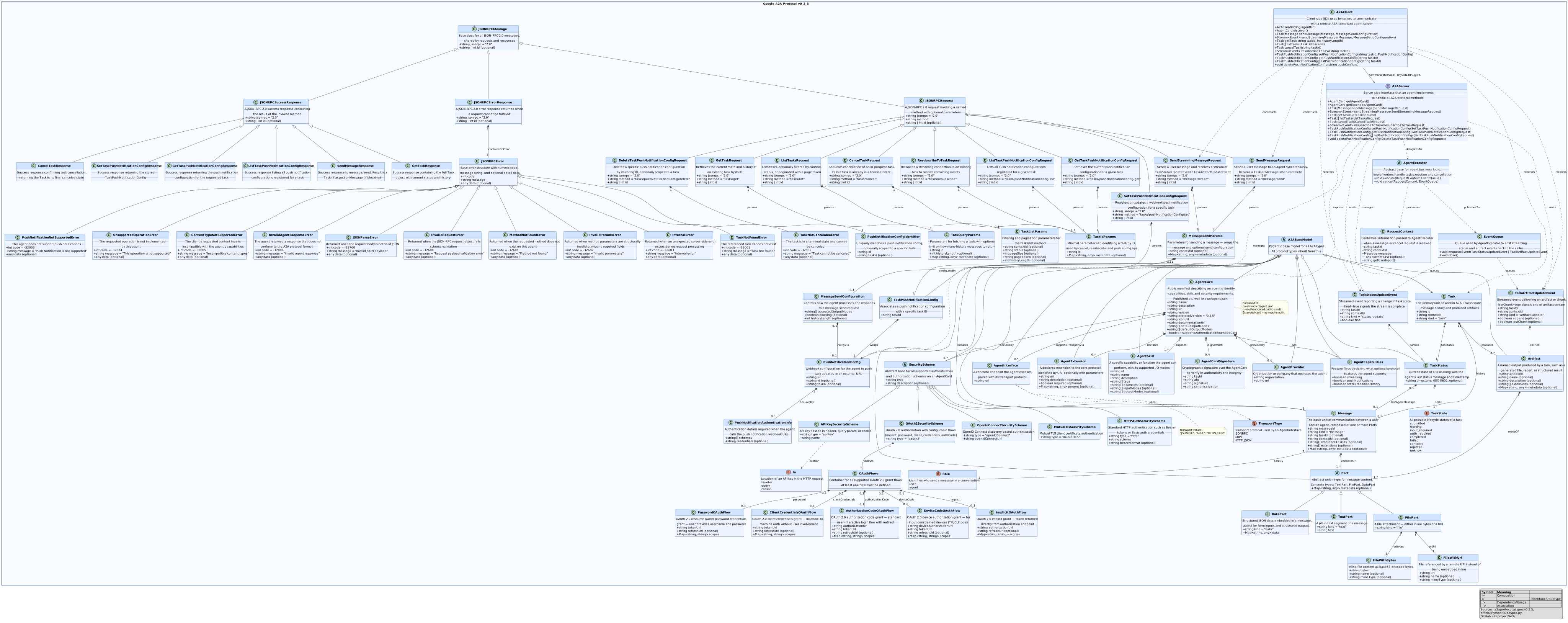
Source of below notes: here
Core Benefits of A2A
Implementing the A2A protocol offers significant advantages across the AI ecosystem:
- Secure collaboration: Without a standard, it’s difficult to ensure secure communication between agents. A2A uses HTTPS for secure communication and maintains opaque operations, so agents can’t see the inner workings of other agents during collaboration.
- Interoperability: A2A breaks down silos between different AI agent ecosystems, enabling agents from various vendors and frameworks to work together seamlessly.
- Agent autonomy: A2A allows agents to retain their individual capabilities and act as autonomous entities while collaborating with other agents.
- Reduced integration complexity: The protocol standardizes agent communication, enabling teams to focus on the unique value their agents provide.
- Support for LRO: The protocol supports long-running operations (LRO) and streaming with Server-Sent Events (SSE) and asynchronous execution.
Key Design Principles of A2A
A2A development follows principles that prioritize broad adoption, enterprise-grade capabilities, and future-proofing.
- Simplicity: A2A leverages existing standards like HTTP, JSON-RPC, and Server-Sent Events (SSE). This avoids reinventing core technologies and accelerates developer adoption.
- Enterprise Readiness: A2A addresses critical enterprise needs. It aligns with standard web practices for robust authentication, authorization, security, privacy, tracing, and monitoring.
- Asynchronous: A2A natively supports long-running tasks. It handles scenarios where agents or users might not remain continuously connected. It uses mechanisms like streaming and push notifications.
- Modality Independent: The protocol allows agents to communicate using a wide variety of content types. This enables rich and flexible interactions beyond plain text.
- Opaque Execution: Agents collaborate effectively without exposing their internal logic, memory, or proprietary tools. Interactions rely on declared capabilities and exchanged context. This preserves intellectual property and enhances security.
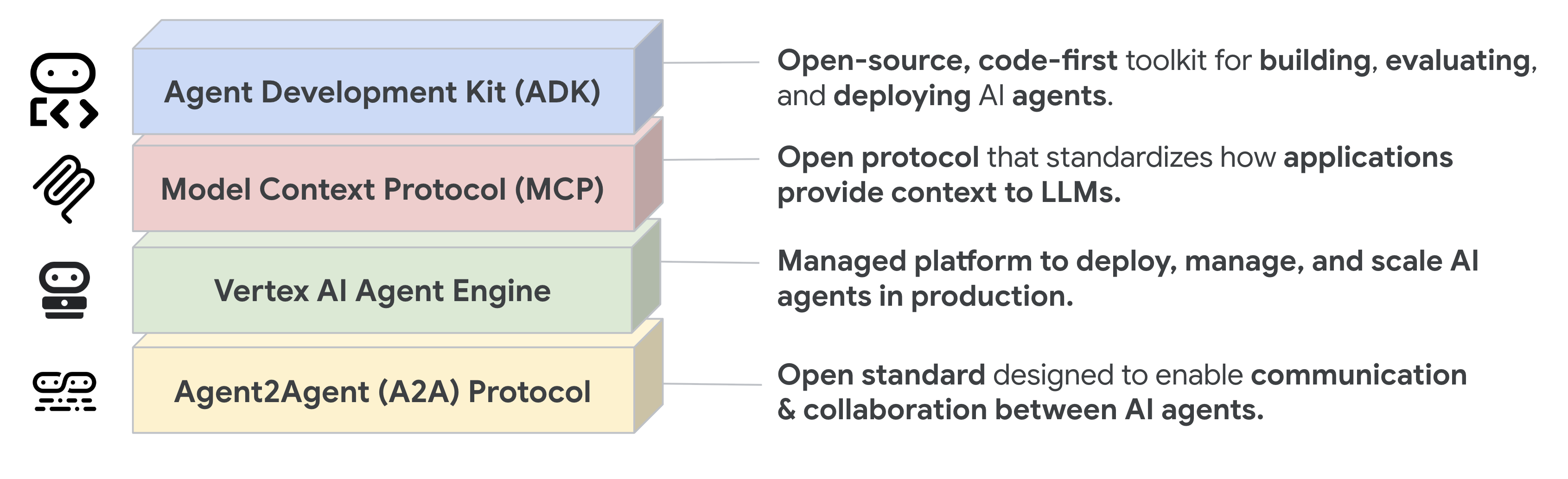
Understanding the Agent Stack: A2A, MCP, Agent Frameworks and Models
A2A is situated within a broader agent stack, which includes:
- A2A: Standardizes communication among agents deployed in different organizations and developed using diverse frameworks.
- MCP: Connects models to data and external resources.
- Frameworks (like ADK): Provide toolkits for constructing agents.
- Models: Fundamental to an agent’s reasoning, these can be any Large Language Model (LLM).
Core Concepts
    graph TB
	    subgraph L1 ["A2A Data Model"]
	        direction LR
	        A[Task] ~~~ B[Message] ~~~ C[AgentCard] ~~~ D[Part] ~~~ E[Artifact] ~~~ F[Extension]
	    end

	    subgraph L2 ["A2A Operations"]
	        direction LR
	        G[Send Message] ~~~ H[Stream Message] ~~~ I[Get Task] ~~~ J[List Tasks] ~~~ K[Cancel Task] ~~~ L[Get Agent Card]
	    end

	    subgraph L3 ["Protocol Bindings"]
	        direction LR
	        M[JSON-RPC Methods] ~~~ N[gRPC RPCs] ~~~ O[HTTP/REST Endpoints] ~~~ P[Custom Bindings]
	    end

	    %% Dependencies between layers
	    L1 --> L2
	    L2 --> L3


	    style A fill:#e1f5fe
	    style B fill:#e1f5fe
	    style C fill:#e1f5fe
	    style D fill:#e1f5fe
	    style E fill:#e1f5fe
	    style F fill:#e1f5fe

	    style G fill:#f3e5f5
	    style H fill:#f3e5f5
	    style I fill:#f3e5f5
	    style J fill:#f3e5f5
	    style K fill:#f3e5f5
	    style L fill:#f3e5f5

	    style M fill:#e8f5e8
	    style N fill:#e8f5e8
	    style O fill:#e8f5e8

	    style L1 fill:#f0f8ff,stroke:#333,stroke-width:2px
	    style L2 fill:#faf0ff,stroke:#333,stroke-width:2px
	    style L3 fill:#f0fff0,stroke:#333,stroke-width:2px
A2A revolves around several key concepts. For detailed explanations, please refer to the Key Concepts guide.
- A2A Client: An application or agent that initiates requests to an A2A Server on behalf of a user or another system.
- A2A Server (Remote Agent): An agent or agentic system that exposes an A2A-compliant endpoint, processing tasks and providing responses.
- Agent Card: A JSON metadata document published by an A2A Server, describing its identity, capabilities, skills, service endpoint, and authentication requirements.
- Message: A communication turn between a client and a remote agent, having a role (“user” or “agent”) and containing one or more Parts.
- Task: The fundamental unit of work managed by A2A, identified by a unique ID. Tasks are stateful and progress through a defined lifecycle.
- Part: The smallest unit of content within a Message or Artifact. Parts can contain text, file references, or structured data.
- Artifact: An output (e.g., a document, image, structured data) generated by the agent as a result of a task, composed of Parts.
- Streaming: Real-time, incremental updates for tasks (status changes, artifact chunks) delivered via protocol-specific streaming mechanisms.
- Push Notifications: Asynchronous task updates delivered via server-initiated HTTP POST requests to a client-provided webhook URL, for long-running or disconnected scenarios.
- Context: An optional, server-generated identifier to logically group related tasks and messages.
- Extension: A mechanism for agents to provide additional functionality or data beyond the core A2A specification. Full Specification