Stop Coding. Start Thinking.
Table of Contents
Choose the work worth mastering
- “it’s not that i’m so smart it’s just that i stay with problems longer” - Albert Einstein
- You could make Ronaldo be a world-class programmer but the question is what is that worth? You are not only wasting time on the wrong thing, you are also stealing time away from the right thing. First things is - It’s very important to decide what work to master.
- Unclaimed territory may make you uncomfortable and company wants us to be master of everything, but ideal combination is you are the best at a few things and average at all the rest.
- You could, in theory, get world-class at almost anything. The constraint is that mastery is expensive: in hours, in attention, in the years it takes before a skill starts compounding. Choosing your focus area isn’t modesty. It’s capital allocation.
- Say you own a company and you need a cafeteria in it - Do you personally learn to run a commercial kitchen or do you hire a caterer and spend your hours perfecting your business?
Learn the rules well enough to understand to break them
- “I fear not the man who has practiced 10,000 kicks once, but I fear the man who has practiced one kick 10,000 times.” - Bruce Lee
- Once you know what you’re mastering, the next decision is learning rules well enough to break them - I emphasise I am not asking you to break any rules I am talking about learning the rules.
- I am telling once again - rules are to be followed exactly, no creative interpretation required: traffic laws, timesheets, your company’s policy.
- These rules exist to catered to the whole society and neceassary to it safe and functioning together. You just comply.
- Newtonian physics worked well for two centuries but Einstein understood Newtonian Physics so well that he questioned Newton’s assumptions that time and space not being absolute: and this is how special theory of relativity was born.
- Rules and protocols are there for a purpose but in your focus area it’s necessary to understand why they exist well in the first place what are the ways around it.
- Think of good penetration tester, or a good doctor, or a good laywer or a great investigator.
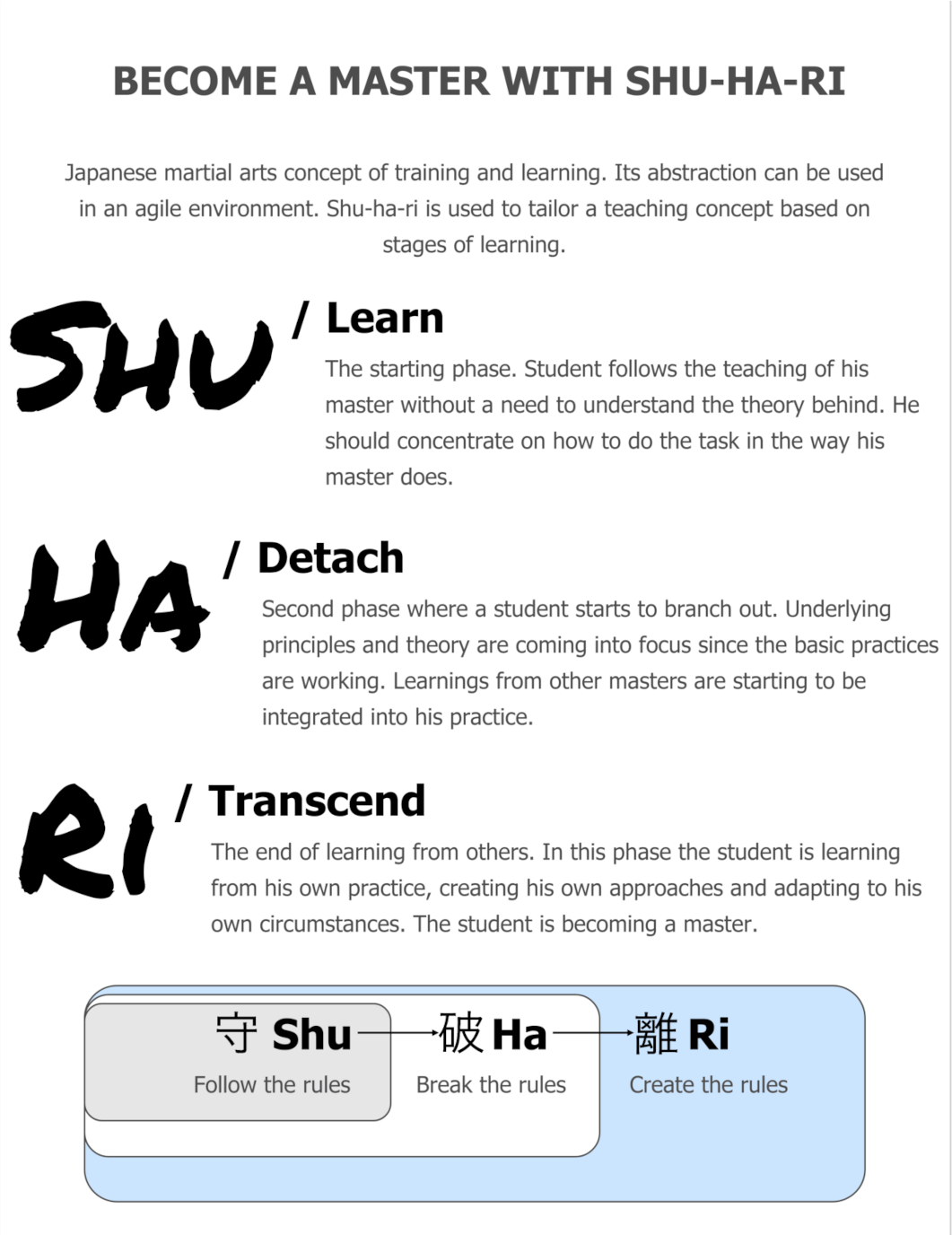
- In Japanese Martial Arts they have something that they call: Shu-Ha-Ri.
- Shu: you follow the rule exactly, without deviation, until it’s second nature. A karate student throws the same basic punch tens of thousands of times right first thing white belt until almost the day they stop practising.
- Ha: you understand why the rule exists, and you start breaking away from it deliberately, in the specific situations where you understand the tradeoff better than the rule’s original author did.
- Ri: you’ve internalized the principle so completely that you’ve built your own form. You’re no longer following the rule or breaking it. You are the rule now, for your context.
- You can see this with mothers cooking - she gave you a recipe. You use the same steps and same ingredients but yet the taste is different.
Developing the Out of the box thinking
- “Nature has already solved many of the problems we are grappling with. Animals, plants, and microbes are the consummate engineers.” - Janine Benyus
- There is the actual payoff of studying nature, politics, chess and military strategy alongside your engineering work. helps build your intuition and rewire your brain.
- Find another area of interest totally out of software:
- Nature
- solved distributed systems: ecosystems and organisms coordinate behavior without a central controller.
- load balancing and fault tolerance: rivers distribute flow, forests recover after damage, and biological systems reroute around failure.
- decentralized coordination or broker model - ant colonies routing foraging paths;
- adaptive resilience: immune systems handling unknown threats without central coordination is an example of ;
- Geopolitics
- Balance-of-power logic: the idea that rival powers prevent any one actor from becoming too dominant. In software, this shows up when no single service, team, or platform becomes the choke point for the whole system.
- clear spheres of influence: distinct areas of control where each actor is expected to operate. In microservices, this is the idea that each service owns its own domain and data within a bounded context.
- buffer zones: neutral or contested spaces that reduce direct conflict between rivals. In engineering, queues, API gateways, and anti-corruption layers act as buffer zones between systems.
- proportional response to provocation: reacting with an amount of force or pressure that matches the offense. In software, this means using retries, rate limiting, or feature flags instead of a full rollback for a small issue.
- alliance behavior: states forming partnerships to increase security or shift the balance of power. In the industry, this looks like platform teams, shared contracts, and strategic partnerships between services or departments.
- escalation dynamics: how small disputes can grow into larger conflicts when each side responds in kind. In distributed systems, a small dependency failure can cascade into a major incident if the response is poorly controlled.
- is the same logic behind bounded contexts in domain-driven design: each service sovereignly owns its data, nothing reaches across the boundary uninvited, and when that boundary gets violated carelessly, you get exactly what geopolitics predicts: coupling, escalation, a mess that’s expensive to unwind.
- Nature
Understand your strengths and weakness - understand your wiring
- “Capitalize on your strengths and outsource your weaknesses.” - Unknown
- Like I said before you can master anything put your heart and time into.
- Different people are built for different kinds of thinking, and the science behind it is more specific than “some people like parties and some don’t.”
- The difference sits in brain chemistry.
- Extroverts are less sensitive to dopamine, so they need more of it: more talking, more movement, more people: to get the same payoff.
- Introverts run more on a acetylcholine quieter chemical that rewards depth, focus, and reflection instead of stimulation.
- I have seen both sides of it some say they are an introvert as if a trend, but the same person uses that to indicate that a person is not social as if its bad.
- According to me its neither good or bad OR right or wrong. In fact most if not all of us are ambiverts but leaning towards one side making it easier to describe as introverts or extroverts. As an individual you must know how to capitalize on your strengths and as a good leaders instead of trying to change a person - you must have the right balance of both and you can work out wonders.
- Given a morally truthful team - one is great at generating ideas and other is great at spreading ideas. Again I emphasise most of us live in the middle zone spectrum of ambiverts, infact some studies say that ambiverts are more successful than either types.
- So dont fight your brain wiring use it to make yourself or your team successful.
Turn your biggest fear into your biggest strength
- “Everything you’ve ever wanted is on the other side of fear.” — George Addair
- You can master anything if you spend enough time on it, that said - its a strange feeling of intoxication if you can turn your biggest fear into your strength. This is one area you know the nook and corner of when you start succeeding here you become unstoppable.
- If you fear something you know the nook and corner of it and if you learn to navigate it you naturally become the best or best.
Appendix